The Accountability Gap: Why Your Team Doesn't Do What They Say
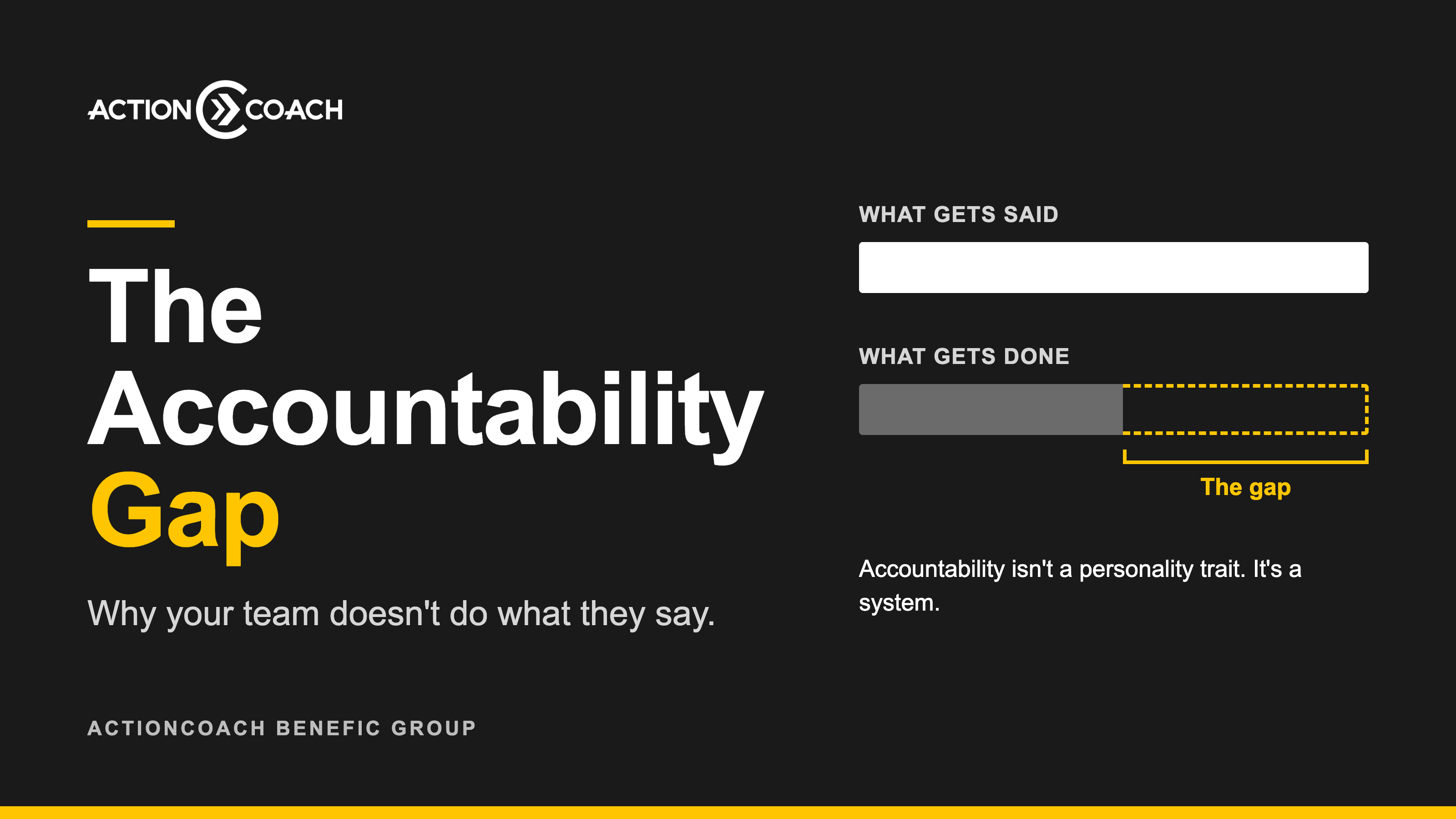
When your team misses commitments, it’s almost never about attitude. Accountability isn’t a personality trait, it’s a system. Here are the four pieces we use to close the gap between what gets said in the meeting and what actually gets done.
You've probably sat in this meeting. It's Monday, the leadership team is around the table, and someone says, "I'll have that proposal out by end of week." Everybody nods. Somebody writes it down, maybe. Friday comes and goes. The next Monday the proposal comes up again, and there's a reasonable explanation. A client fire. A vendor who didn't call back. Then it happens again with a different person and a different task, and eventually the owner lands on the conclusion that feels obvious: these people just aren't accountable.
We see this pattern in almost every business we walk into, and we'd push back on that conclusion. Accountability isn't a personality trait your team either has or doesn't. It's a system. When people don't follow through, it's almost never about attitude. It's about what the business makes easy and what it lets slide.
Look at the numbers. Gallup's research across companies worldwide finds that only about half of employees strongly agree they know what's expected of them at work, and only about one in three say their manager helps them set performance goals. Think about that for a second. In a typical business, roughly half the team couldn't tell you with confidence what "done" looks like. You can't hold someone to a target they can't see.
And the problem doesn't sit only with the team. In a multi-year study of more than 40,000 people, Partners In Leadership found that 82% of respondents said they had limited to no ability to hold others accountable successfully. Gallup's research on managers lands in the same place from a different angle: the manager accounts for at least 70% of the variance in team engagement. Put those together and the picture gets uncomfortable. The accountability gap usually isn't a people problem. It's a leadership system problem, and the leader is the one who built the system, whether they meant to or not.
Most owners respond to missed commitments by trying harder in the moment. More reminders. A sharper tone. A Slack message at 9pm. That's heroics, and heroics don't scale. What works is boring, repeatable structure. We use four pieces.
The four pieces
One owner per commitment. "We'll get that done" is how things die. If two people own it, nobody owns it. Every commitment that leaves a meeting gets one name attached.
A specific "done by when." "This week" isn't a deadline. Thursday at 3pm is. Vague timing gives everyone a polite way out, including you.
A visible scoreboard. Commitments that live in someone's head, or in meeting notes nobody opens, might as well not exist. Put them somewhere the whole team sees, where a missed date shows up without anyone having to point at it. That's what takes the emotion out. The scoreboard does the reminding so you don't have to.
A weekly check-in where people report on their own commitments. This flips the dynamic. Instead of the owner chasing, each person walks in and says what they committed to, whether it got done, and if not, what they're doing about it. Accountability stops being something you do to people and becomes something they do for themselves, in front of their peers.
None of this is complicated, and that's kind of the point. The hard part isn't knowing it. It's running it the same way every week, especially the weeks you're slammed and it feels easier to skip.
What about the person who still doesn't deliver?
It's a fair question, and it happens. But here's the order of operations we'd hold to: build the system first, run it for a few weeks, and then look at who's still missing. At that point you're having a different conversation, one about fit instead of effort, and you've earned the right to have it because the expectations were clear, visible, and agreed to. Most owners skip straight to that conversation without the system in place, and that's how good people get labeled as bad hires.
So before you decide your team has an accountability problem, ask yourself this: if we pulled the last five commitments made in your leadership meeting, how many had one owner, a real deadline, and a place where anyone could see whether they got done?
If that question made you wince a little, you're in good company. It's also the exact gap we work on with owners every week. Apply for two weeks of free coaching with ActionCOACH Benefic Group, and let's help you become the leader your team needs.
---
Sources: Gallup, "Many Employees Don't Know What's Expected of Them at Work" (news.gallup.com/businessjournal/186164); Gallup, "Managers Account for 70% of Variance in Employee Engagement" (news.gallup.com/businessjournal/182792); Partners In Leadership, Workplace Accountability Study (via HR Dive, hrdive.com/news/study-workplace-accountability-requires-a-specific-strategy/400130).